Oil Palm Plantation Spacing: 7m, 8m or 9m — Which Is Best?
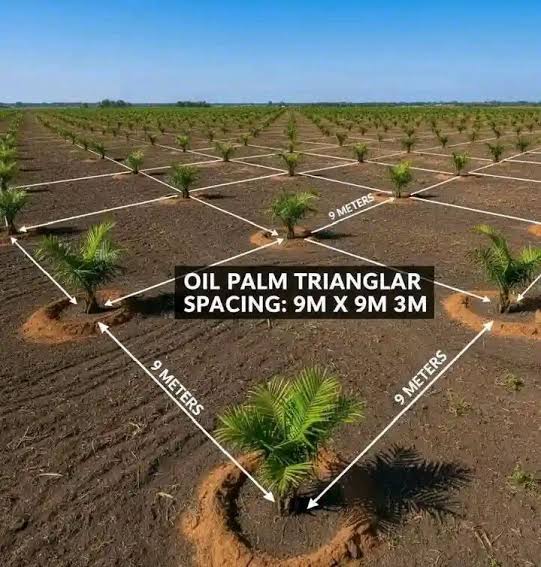
Planting spacing is one of the most important decisions a young oil palm farmer must make before establishing a plantation. The distance between palms affects how many trees you can plant per hectare, how much sunlight each palm receives, how easily workers can move around the plantation, and ultimately how well the palms perform as they mature.
A common question among new farmers is: Should I plant oil palm at 7 metres, 8 metres or 9 metres?
There is no single spacing that is perfect for every plantation. However, for many commercial oil palm plantations, about 9 metres between palms is commonly preferred, particularly when using triangular planting arrangements. The correct choice depends on the palm variety, planting system, soil fertility, management level and long-term growth of the palms.
Why Oil Palm Spacing Matters
Oil palm is a long-term crop. A plantation can remain productive for many years, so spacing mistakes made during planting can become difficult and expensive to correct later.
If palms are planted too close together, they may compete heavily for:
- Sunlight
- Water
- Nutrients
- Rooting space
- Air circulation
As the palms become older and their canopies expand, overcrowding can become a serious problem.
On the other hand, planting palms too far apart can leave too much unused space. This means fewer palms per hectare and potentially lower production per hectare, especially during the early and middle years of the plantation.
The goal is therefore to find a spacing that gives each palm enough room to develop while maintaining an efficient number of productive palms per hectare.
7 Metres Spacing: Is It Good for Oil Palm?
A spacing of 7 metres is relatively close for oil palm, depending on how the distance is measured and the planting pattern being used.
The main advantage is that more palms can potentially fit into a given area.
However, young farmers should not choose 7 metres simply because it allows them to plant more trees.
As the palms mature, their leaves and crowns become much larger. Closely planted palms can begin competing strongly with one another.
Possible problems include:
- Increased competition for sunlight
- Greater competition for nutrients and water
- Difficulty moving workers and equipment through the plantation
- More crowded palm canopies
- Reduced efficiency as palms become mature
Therefore, 7 metres should not automatically be considered the best commercial spacing just because it produces a higher planting density.
Before using such close spacing, a farmer should have a strong technical reason and should consider the palm material, planting arrangement and expected mature canopy size.
8 Metres Spacing: A Middle Option
8 metres can be considered a middle-ground spacing.
It provides more room than 7 metres while allowing a relatively high number of palms per hectare.
For some farmers, this may appear attractive because they want to balance planting density with available space.
However, the same principle still applies: the farmer must consider what the plantation will look like 10, 15 or 20 years after planting, not just during the first few years.
A plantation that looks comfortably spaced when the palms are young may become crowded once the crowns expand.
9 Metres Spacing: Why Many Farmers Prefer It
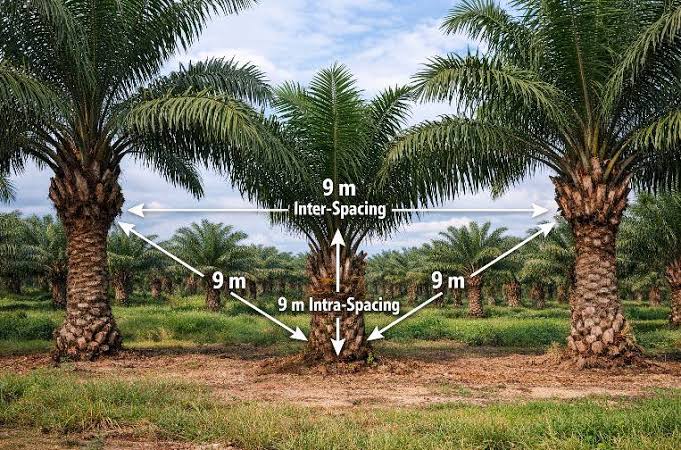
For many commercial oil palm plantations, 9 metres is a commonly used spacing, especially when palms are arranged in a triangular pattern.
The larger distance gives mature palms more room for their crowns and root systems.
Benefits can include:
- Better access to sunlight
- Reduced competition between mature palms
- Easier movement within the plantation
- Better access for harvesting and maintenance
- More room for the palm canopy to develop
- Improved long-term plantation management
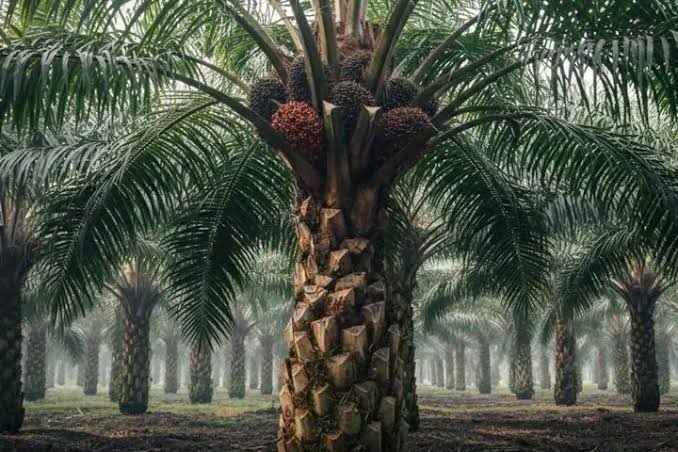
This does not mean that every farm must use exactly 9 metres. The appropriate spacing should still be based on the planting material and local agronomic recommendations.
The Planting Pattern Also Matters
One important point that young farmers sometimes overlook is that spacing cannot be considered by distance alone.
The arrangement of the palms is also important.
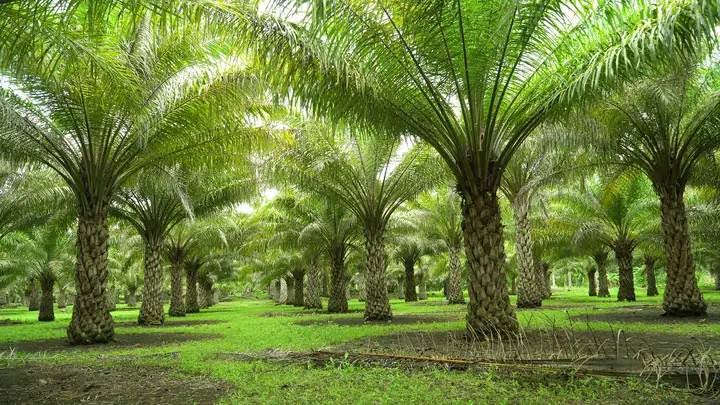
Oil palm is commonly planted using a triangular or equilateral-triangle arrangement because it distributes palms more efficiently across the land.
With triangular planting, rows are staggered rather than placing every palm directly opposite another palm.
This can improve the use of available space and help maintain more uniform distances between neighbouring palms.
How Many Oil Palms Can You Plant Per Hectare?
The number of palms that fit into one hectare depends on the spacing and the planting pattern.
For example, using a triangular arrangement, the approximate planting densities are:
| Spacing | Approximate palms per hectare |
|---|---|
| 7 m | About 236 palms |
| 8 m | About 180 palms |
| 9 m | About 143 palms |
These figures are approximate and assume a regular triangular arrangement without allowing for roads, drains, buildings, turning areas or other plantation infrastructure.
In a real plantation, the actual number of productive palms per hectare can therefore be lower.
Does More Palms Mean More Money?
Not necessarily.
This is one of the most important lessons for a young plantation farmer.
It may seem logical that planting 200 palms is better than planting 140 palms because there are more trees. But oil palm production is not simply about the number of trees.
Each palm needs adequate:
- Sunlight
- Nutrients
- Water
- Root space
- Canopy space
- Proper maintenance
If too many palms are planted in a limited area, competition can increase as the plantation matures.
The objective should be maximum sustainable production per hectare, not simply the maximum number of seedlings planted.
What Happens If Oil Palms Are Planted Too Closely?
Overcrowding may not be obvious when the palms are young.
A young plantation can look excellent even when the final spacing is too close.
The problem becomes more visible as the palms develop large crowns.
Closely planted mature palms can create excessive shade and competition. Harvesting may also become more difficult because workers have less room to move between the palms.
This is why spacing should be planned based on the mature size of the palm, rather than its size immediately after planting.
What Happens If Palms Are Planted Too Far Apart?
Excessive spacing has the opposite problem.
There may be large areas of unused land between palms, particularly during the early years.
This means the farmer has fewer productive palms occupying each hectare.
Wide spacing can also increase the amount of land that remains exposed to sunlight, which may encourage weed growth and increase maintenance requirements.
However, wider spacing may sometimes be appropriate depending on the planting material, site conditions and management system.
Factors to Consider Before Choosing Your Spacing
A young farmer should consider more than the distance between seedlings.
1. Oil Palm Variety
Different planting materials can have different growth characteristics.
Farmers should obtain proper information about the planting material from the nursery or recognised agricultural source before deciding on spacing.
Do not choose spacing simply because another farmer uses it.
2. Soil Fertility
Good soil fertility supports strong palm growth.
On highly fertile land with good management, palms may develop vigorously and require adequate space as their crowns expand.
Soil testing can help you understand the condition of your land before establishing the plantation.
3. Rainfall and Water Availability
Oil palm requires adequate water for good growth and production.
The availability of water and the drainage condition of the farm should be considered when planning the plantation.
4. Plantation Management
Think about how you will maintain the plantation.
Can workers easily move between the palms?
Can you harvest the fruit bunches efficiently?
Can you apply fertilizer properly?
Can you control weeds?
Can you transport harvested fruit from the field?
A spacing that makes plantation operations difficult may create problems later.
5. Long-Term Canopy Development
Never judge spacing only by looking at a two-year-old plantation.
Imagine the same palms when they are mature.
Their fronds will become much larger, and the canopy will occupy considerably more space.
Should a Young Farmer Choose 7m, 8m or 9m?
For a farmer establishing a conventional commercial oil palm plantation, 9 metres is often the safer starting point among these three options, particularly when using a suitable triangular planting arrangement.
However, this should not be treated as a universal rule.
The best spacing depends on the planting material, local conditions and the technical recommendation for the plantation.
If you are considering 7 metres or 8 metres, do not choose the spacing simply because you want to increase the number of seedlings per hectare.
Instead, ask whether the palms will still have adequate space when they reach maturity.
Practical Advice Before Planting
Before you start digging planting holes, take these steps:
First, obtain genuine, properly identified oil palm planting material.
Second, determine the boundaries and total plantable area of your farm.
Third, map out roads, drainage channels and other areas that cannot be planted.
Fourth, choose your planting pattern and spacing before bringing the seedlings into the field.
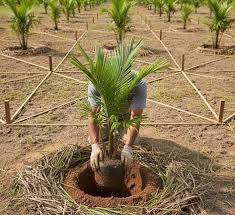
Fifth, use ropes, pegs or a proper field layout system to maintain uniform spacing.
Sixth, avoid estimating distances by simply walking between planting points. Use accurate measurements.
Finally, if possible, obtain advice from an experienced oil palm agronomist or agricultural extension professional familiar with your area.
Common Spacing Mistakes Young Farmers Should Avoid
Planting Too Close Because You Want More Palms
More seedlings do not automatically mean more profit.
Copying Another Farmer’s Spacing
A spacing that works on another farm may not be appropriate for your variety, soil or management system.
Ignoring the Mature Palm
Always plan for the mature plantation, not only the young plantation.
Measuring Spacing Incorrectly
Small errors during field layout can accumulate across a large plantation.
Forgetting Roads and Drainage
Not every square metre of a farm should necessarily contain an oil palm.
Proper plantation design must allow access and water management.
Final Recommendation
When comparing 7m, 8m and 9m spacing, young farmers should think about long-term productivity rather than simply the number of seedlings they can plant.
7 metres gives a higher planting density but can create greater competition as palms mature.
8 metres provides an intermediate option but still requires careful consideration of the variety and mature canopy.
9 metres generally provides more growing room and is commonly used in commercial oil palm planting systems, particularly with triangular planting.
The most important lesson is this:
Do not choose oil palm spacing based only on how many seedlings you can fit into one hectare. Choose spacing that allows the palms to remain productive, accessible and manageable throughout their productive life.
For a young plantation farmer in Nigeria, getting the spacing right before planting is much easier and cheaper than trying to correct a badly overcrowded plantation later.
Leave a Reply