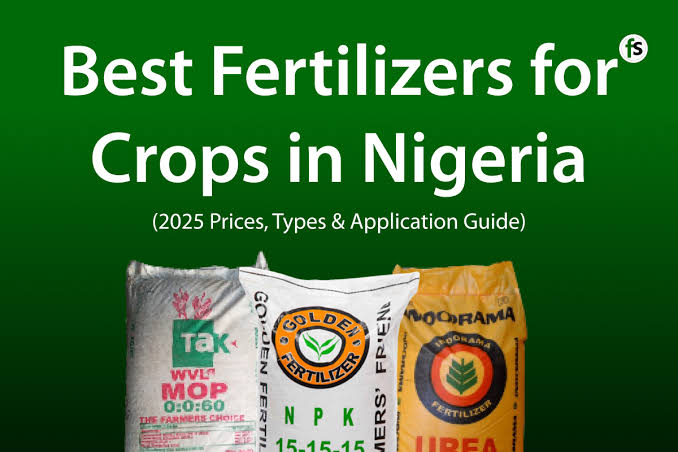
Best Fertilizer for Oil Palm Trees in Nigeria
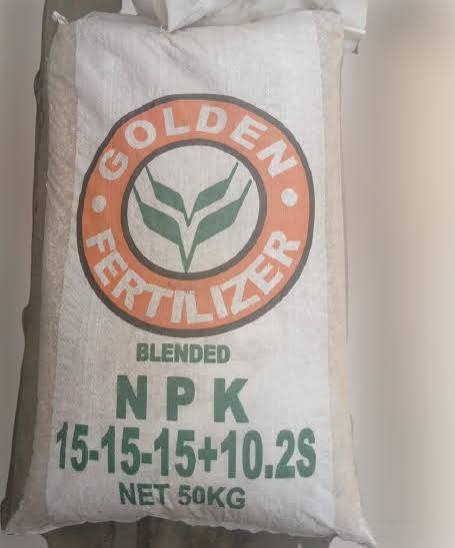
Oil palm is a heavy-feeding crop. A healthy oil palm plantation needs adequate nutrients to produce strong leaves, develop a large canopy, form fruit bunches and maintain good yields over many years.
For a young plantation farmer in Nigeria, however, choosing fertilizer should not simply mean buying any bag labelled NPK and applying it around every palm. The right fertilizer and quantity depend on the palm’s age, soil condition, rainfall, yield level and nutrient status.
Research associated with the Nigerian Institute for Oil Palm Research (NIFOR) has emphasized that fertilizer requirements for oil palm are site-specific. Nitrogen (N), phosphorus (P), potassium (K) and magnesium (Mg) are among the nutrients commonly required in significant amounts.
This guide explains what young plantation farmers should know before spending money on fertilizer.
Why Fertilizer Is Important for Oil Palm
Oil palm continuously removes nutrients from the soil as it grows and produces leaves and fruit bunches. If those nutrients are not replaced, soil fertility can decline.
A palm plantation with inadequate nutrition may show:
- Slow growth
- Small or pale leaves
- Poor canopy development
- Weak stems
- Poor fruit-bunch development
- Reduced yield
- Nutrient-deficiency symptoms
- Poor recovery after periods of stress
This is why fertilizer management should be treated as a major part of plantation management rather than something done only when the palms appear unhealthy.
NIFOR research has specifically linked low soil fertility and nutrient imbalance with poor growth and declining oil-palm yields. (ResearchGate)
So, What Is the Best Fertilizer for Oil Palm?
There is no single fertilizer that is automatically the best for every oil-palm plantation in Nigeria.
A balanced fertilizer containing N, P, K and sometimes Mg can be useful, but the best formulation is the one that supplies the nutrients your particular plantation needs.
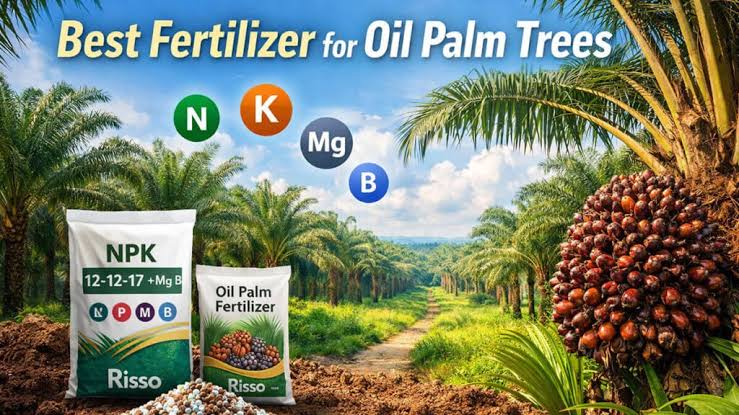
One fertilizer formulation that has been studied at NIFOR is NPKMg 12:12:17:2. Research on oil-palm nursery production and field trials has investigated this formulation, while other NPK formulations have also been evaluated.
The important lesson for a young farmer is:
Do not choose fertilizer because another farmer is using it. Choose it because your palms and soil need those nutrients.
Understanding NPK in Oil Palm Fertilizer
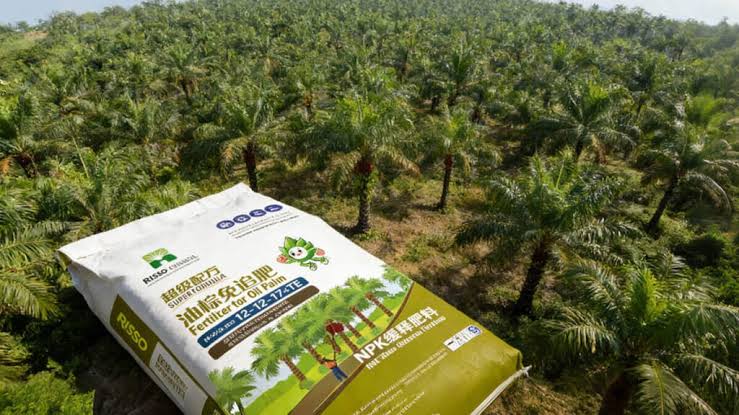
When you see something such as NPK 12:12:17, the numbers represent the guaranteed percentages of the major nutrients in the fertilizer.
N = Nitrogen
Nitrogen is particularly important for vegetative growth.
It helps the palm produce:
- Healthy green leaves
- Strong vegetative growth
- A larger canopy
- Adequate leaf area for photosynthesis
Young palms need sufficient nitrogen because they are building their canopy and root system.
However, more nitrogen does not automatically mean better palms. Excessive nitrogen can create an imbalance with other nutrients and waste money.
P = Phosphorus
Phosphorus is involved in important plant processes, including root development and energy transfer.
For young palms, adequate phosphorus can support establishment and root development.
But phosphorus should not simply be applied at a high rate without considering the soil. Tropical soils can differ considerably in their phosphorus status.
K = Potassium
Potassium is one of the most important nutrients in oil-palm production.
It plays important roles in:
- Water regulation
- Plant strength
- Nutrient movement
- Stress tolerance
- Fruit production
- Yield development
As palms become productive, potassium can become particularly important because the crop removes substantial nutrients through harvested fruit bunches.
This is why a mature plantation should not be managed as though it has the same nutritional requirements as newly planted palms.
Mg = Magnesium
Magnesium is essential because it is a central component of chlorophyll, which allows leaves to capture light for photosynthesis.
A magnesium deficiency can contribute to abnormal leaf coloration, particularly on older leaves.
This is one reason some oil-palm fertilizers include magnesium, such as NPKMg 12:12:17:2.
Fertilizer for Young Oil Palm Trees
Young palms require nutrients for rapid establishment.
For practical management, think about young palms in stages rather than treating a one-year-old palm exactly like a three-year-old palm.
1. Newly Established Palms
After transplanting, the main objectives are:
- Establishing the root system
- Producing healthy new leaves
- Developing the stem
- Building a strong canopy
Do not immediately assume that a large quantity of fertilizer will make a newly transplanted palm grow faster.
The fertilizer must be applied correctly and at the appropriate stage.
Good weed management, adequate moisture, mulching where appropriate and proper planting are also important.
2. One- to Three-Year-Old Palms
At this stage, the palm is developing rapidly and nutrient demand increases.
Research-based fertilizer guides for immature palms show that nutrient requirements can increase as palms move from their first year into the second and third years.
For example, published general guidance for immature palms on mineral soils lists different annual ranges for nitrogen, phosphorus, potassium and magnesium according to the year after planting.
These figures should be treated as reference ranges rather than a universal Nigerian prescription, because Nigerian soils and plantation conditions differ.
The correct rate should ideally be determined from soil and leaf information and local agronomic recommendations.
3. Four- to Six-Year-Old Palms
This is an important transition period.
The palms are developing a much larger canopy and moving toward or into substantial production.
General oil-palm fertilizer guidance indicates that young mature palms around 4–6 years may require substantially more nitrogen than older mature palms in some situations because they are still developing a large canopy.
This is one reason farmers should not use the same fertilizer programme throughout the entire life of the plantation.
Fertilizer for Mature Oil Palm Trees
Once the palms are mature and producing bunches, fertilizer management becomes closely connected with yield.
A mature palm removes nutrients from the field through:
- Fruit bunches
- Leaves
- Pruned fronds
- Other plant material
The nutrients removed through harvested bunches must be replaced over time if the plantation is to remain productive.
Potassium deserves particular attention in productive plantations because of its important role in yield and plant function.
Published oil-palm fertilizer guidance for mature palms on mineral soils, for example, gives separate reference ranges for nitrogen, phosphorus, potassium and magnesium and adjusts requirements according to yield level.
Again, these figures should not be copied blindly into every Nigerian farm.
Why Soil Testing Is So Important
One of the biggest mistakes a young farmer can make is buying fertilizer before knowing what the soil needs.
Two farms located in different parts of Nigeria can have very different soil properties.
One farm may need more potassium.
Another may have adequate potassium but require attention to nitrogen or magnesium.
Another may have a phosphorus issue.
This is why fertilizer recommendations should be site-specific.
Research reviewing Nigerian oil-palm fertilizer studies specifically emphasized that fertilizer requirements vary according to soil and site conditions.
A soil test can help determine factors such as:
- Soil pH
- Organic matter
- Nitrogen status
- Available phosphorus
- Exchangeable potassium
- Magnesium
- Calcium
- Other important soil properties
Instead of asking:
“Which fertilizer is best?”
A better question is:
“Which nutrients are limiting my palms, and how much do they need?”
That change in thinking can save a farmer money.
Why Leaf Analysis Is Also Important
Soil testing tells you about the nutrient condition of the soil, but leaf analysis provides information about what the palm is actually taking up.
This is particularly useful in established plantations.
Oil-palm researchers use standardized leaf sampling for nutrient diagnosis. One NIFOR field study, for example, sampled soil and specific oil-palm leaflets to examine nutrient status and fertilizer treatments.
Leaf analysis can help identify whether the palm is receiving adequate levels of nutrients such as:
- Nitrogen
- Phosphorus
- Potassium
- Magnesium
- Other essential nutrients
For a commercial plantation, combining soil analysis + leaf analysis + field observations + yield records can give a much better basis for fertilizer decisions than visual observation alone.
Don’t Diagnose Every Yellow Leaf as Nitrogen Deficiency
This is another important lesson for young farmers.
If a palm leaf changes colour, do not immediately conclude:
“The palm needs more nitrogen.”
Different nutrient deficiencies can produce different symptoms, and some symptoms can look similar.
Problems can also be caused by:
- Poor drainage
- Drought
- Root damage
- Weeds
- Soil acidity
- Pest problems
- Diseases
- Nutrient imbalance
Therefore, visual symptoms are useful warning signs, but they should not always be treated as a complete diagnosis.
Where possible, confirm the problem through soil and/or leaf analysis and professional agronomic advice.
Should Young Farmers Use NPK 12:12:17:2?
NPKMg 12:12:17:2 is a useful example because it supplies nitrogen, phosphorus, potassium and magnesium in one compound fertilizer, and it has been studied in oil-palm production at NIFOR.
But the presence of those four nutrients does not mean it is automatically the perfect fertilizer for every plantation.
For example, if your soil already has adequate phosphorus but is low in potassium, your fertilizer programme may need to emphasize potassium rather than simply applying more of a balanced NPK fertilizer.
Similarly, if magnesium is deficient, a magnesium-containing fertilizer or an appropriate magnesium amendment may be considered.
The fertilizer should match the deficiency.
What About MOP (Muriate of Potash)?
MOP, commonly called muriate of potash or potassium chloride, is a concentrated potassium fertilizer.
Potassium is particularly important in oil-palm production, and MOP has been included in fertilizer research and recommendations for oil palm. NIFOR field research has also examined NPKMg 12:12:17:2 combined with MOP treatments. (TASR)
However, a farmer should not automatically add MOP to every plantation.
The correct question is:
Does my plantation actually need additional potassium?
A soil and leaf analysis can help answer that.
Organic Manure Can Also Play a Role
Fertilizer management does not necessarily mean using only chemical fertilizer.
Well-managed organic materials can contribute nutrients and organic matter to the soil.
Depending on what is safely and practically available, farmers may use properly decomposed organic materials such as:
- Compost
- Well-decomposed animal manure
- Suitable oil-palm residues
- Other properly managed organic amendments
Research at NIFOR has also investigated organic materials and alternatives to conventional fertilizers in oil-palm seedling production. (Nigerian Journal of Soil Science)
However, organic manure should not automatically be considered a complete replacement for mineral fertilizer in a commercial plantation. Its nutrient content can vary considerably.
How Should Fertilizer Be Applied?
Correct application is almost as important as choosing the correct fertilizer.
Avoid simply pouring fertilizer directly against the trunk.
Oil palm has an extensive root system, and fertilizer should generally be distributed in the appropriate root-feeding area rather than concentrated in one small spot.
Farmers should also:
- Follow the recommended rate.
- Apply fertilizer when soil moisture is suitable.
- Avoid unnecessary application immediately before heavy rainfall.
- Keep fertilizer away from direct contact with the trunk.
- Split applications when recommended.
- Keep the plantation reasonably free from competing weeds.
- Record the fertilizer type, rate and application date.
Splitting fertilizer applications can help improve nutrient-use efficiency and reduce losses, depending on the nutrient, soil and local conditions.
Never Think “More Fertilizer Means More Yield”
This is one of the most important lessons for a new plantation farmer.
Applying too little fertilizer can limit growth and yield.
But applying too much can also be harmful.
It can:
- Waste money
- Increase nutrient losses
- Create nutrient imbalance
- Increase the risk of environmental pollution
- Fail to correct the actual deficiency
The objective is not to apply the maximum amount of fertilizer.
The objective is to apply the right nutrient, at the right rate, at the right time and in the right place.
A Simple Fertilizer Strategy for a Young Nigerian Palm Farmer
A practical approach is:
Step 1: Identify the age of your palms.
Step 2: Know your soil type and plantation conditions.
Step 3: Conduct a soil test.
Step 4: For established palms, consider leaf nutrient analysis.
Step 5: Identify which nutrients are actually limiting growth or production.
Step 6: Select a fertilizer formulation that supplies those nutrients.
Step 7: Apply the recommended quantity correctly.
Step 8: Keep records of fertilizer applications.
Step 9: Monitor palm growth, leaf condition and fruit-bunch production.
Step 10: Review the fertilizer programme periodically rather than using exactly the same programme forever.
Common Fertilizer Mistakes Young Farmers Should Avoid
1. Copying another farmer’s fertilizer rate
Your neighbour’s soil may be completely different from yours.
2. Applying fertilizer without knowing the palm’s age
Young and mature palms have different nutritional requirements.
3. Focusing only on NPK
Oil palm needs more than three nutrients. Magnesium and micronutrients can also become important.
4. Applying too much fertilizer
More fertilizer does not necessarily produce more bunches.
5. Ignoring potassium
Potassium is an important nutrient in productive oil palms and should not be overlooked.
6. Ignoring magnesium
Magnesium contributes to healthy photosynthetic leaves and should be considered where deficiency exists.
7. Relying only on leaf colour
Visual symptoms can help identify problems, but they are not a substitute for proper diagnosis.
8. Fertilizing while ignoring weeds
Weeds compete with young palms for water and nutrients.
9. Failing to keep records
A farmer who records fertilizer rates, dates, palm age and yields can make much better decisions over time.
10. Buying fertilizer only because it is cheap
A cheaper fertilizer is not necessarily cheaper per unit of nutrient or better for your plantation.
Final Advice for Young Oil Palm Farmers
If you are starting an oil-palm plantation in Nigeria, don’t make fertilizer selection a guessing game.
NPK provides the major nutrients nitrogen, phosphorus and potassium. Magnesium is also important, while other nutrients may become necessary depending on the plantation.
Young palms generally need strong nutritional support to establish roots, stems and canopy, while mature palms have nutritional requirements increasingly connected with fruit-bunch production and nutrient removal.
Products such as NPKMg 12:12:17:2 have been studied in Nigerian oil-palm production, but that does not mean every farm should receive the same fertilizer at the same rate. (ResearchGate)
The strongest approach is to combine:
Soil analysis + leaf analysis + palm age + field observation + yield records + professional fertilizer recommendations.
NIFOR remains an important Nigerian source of oil-palm research, planting material and agronomic knowledge, so young farmers should make use of credible research and extension sources rather than relying only on fertilizer dealers or informal advice. (NIFOR)
The golden rule
Don’t ask only, “Which fertilizer is best for oil palm?”
Ask:
“What nutrients does my plantation need, and what fertilizer can supply them at the correct rate?”
That approach can help a young farmer reduce unnecessary fertilizer costs, maintain soil fertility and build a healthier, more productive oil-palm plantation over the long term.
Leave a Reply