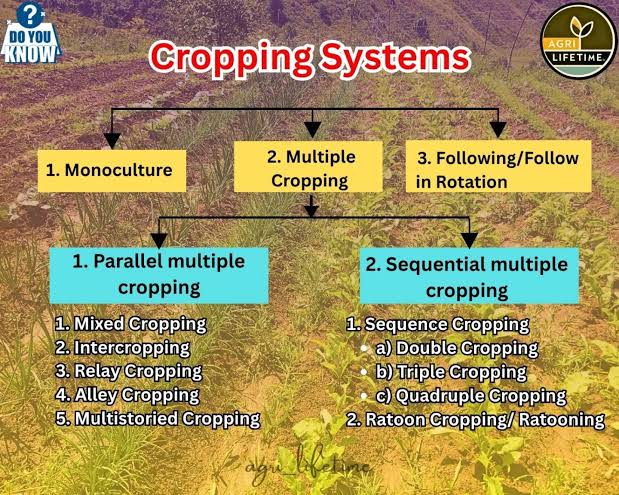
The term cropping system refers to the crops and crop sequences, as well as the management techniques used on a particular field over the years.

The cropping system represents crop (cropping) patterns used on the farm and their interactions with farm resources, other farm enterprises, and available technology, which determine their makeup.
A crop pattern means the proportion of the area under various crops at a point in time in a unit area. It indicates the yearly sequence and spatial arrangement of crops and fallow in an area.
The traditionally used cropping systems are monoculture, intercropping, crop rotation, fallow systems, shifting cultivation, strip cropping, multiple cropping, contour strip cropping, and cover crops.
Types of Cropping Systems:
(a) Monocropping (Monoculture): Monocropping involves growing only one crop on a piece of land year after year. This may be due to climatological or socioeconomic conditions, or because the farmer specializes in growing a particular crop, such as rice cultivation.
(b) Multiple Cropping: Multiple cropping involves growing two or more crops on the same piece of land within one calendar year.
(c) Contour Strip Cropping: Contour strip cropping alternates strips of closely sown crops, such as hay, wheat, or other small grains, with strips of row crops, such as corn, soybeans, cotton, or sugar beets. This technique helps to stop soil erosion by creating natural dams for water, thereby preserving soil strength.
(d) Strip Cropping: Strip cropping involves alternating closely sown strip crops, such as cotton, corn, sugar beets, soybeans, etc., with small grains, such as millet, wheat, or hay.
(e) Shifting Cultivation: Shifting cultivation is an agricultural system in which plots of land are cultivated temporarily, then abandoned while post-disturbance fallow vegetation is allowed to freely grow while the cultivator moves on to another plot.
(f) Intercropping: Intercropping is the growing of two or more crops simultaneously on the same piece of land with a definite row pattern, such as Jowar + Tur, Cotton + Soya bean. Intercropping is divided into two types: additive series and replacement series, based on the percentage of plant population used for each crop in the intercrop system.
- Additive Series: In this series, one crop is sown with 100% of its recommended population in the pure stand, which is known as the base crop. Another crop, known as an intercrop, is introduced into the base crop by adjusting or changing crop geometry. The population of the intercrop is less than its recommended population in the pure stand.
- Replacement Series: In these, both crops are called component crops. By sacrificing a certain proportion of the population of one component, another crop is introduced. The main objective of intercropping is higher productivity per unit area, in addition to stability in production and utilizing resources efficiently to increase productivity.
For successful intercropping, certain important requirements must be met. The time of peak nutrient demands of component crops should not overlap, competition for light should be minimum among the component crops, complementary should exist between the component crops, and the difference in the maturity of component crops should be at least 30 days.
Leave a Reply