Chicken Breeds in Nigeria: Complete Guide for Young Chicken Farmers
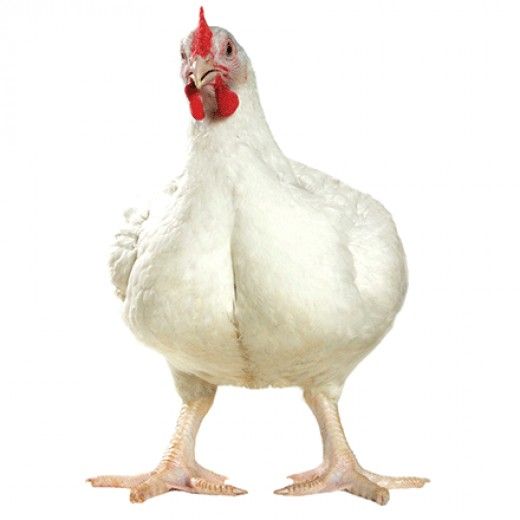
Choosing the right chicken breed is one of the most important decisions a farmer makes. A breed that performs well for eggs may not be the best choice for meat, while a breed that grows quickly may require more expensive feed and better management.
For Nigerian farmers, breed selection should consider purpose, feed cost, climate, disease management, market demand, housing system and availability of quality chicks.
The figures below are practical ranges rather than guarantees. Actual performance varies according to genetics, feed quality, vaccination, housing, disease pressure, temperature and management.
⸻
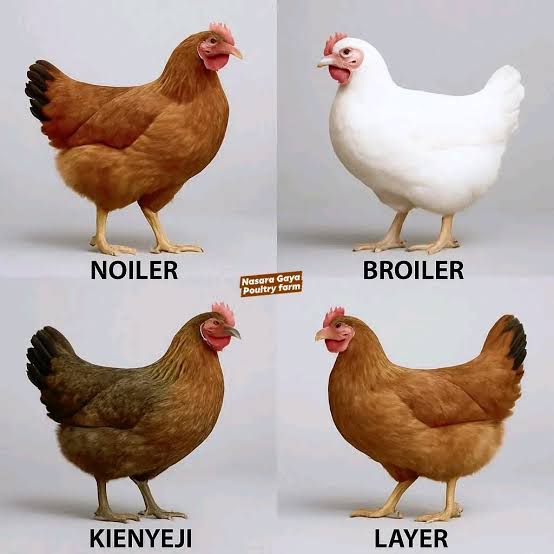
1. Noiler Chicken
Noiler is a popular Nigerian-developed dual-purpose chicken. It is particularly attractive to small and medium-scale farmers because it can be raised for both meat and eggs.
Growth rate
Noilers generally grow faster than traditional local chickens but are slower than specialized commercial broilers. Under good management, they can reach marketable meat weight within a few months.
Feed consumption
Feed consumption depends on age and production purpose. Growing birds require starter and grower diets, while laying birds require layer feed. Farmers should monitor body weight rather than feeding blindly.
Egg production
A well-managed Noiler hen can produce a useful number of eggs, although egg production is generally lower than that of specialized commercial layers.
Maturity age
Noilers mature earlier than most indigenous chickens. Some hens can begin laying at roughly 5–6 months, depending on genetics and management.
Advantages
- Dual-purpose bird
- Better suited to many smallholder systems
- Can provide both meat and eggs
- More robust than some specialized commercial birds
- Good market acceptance in Nigeria
Disadvantages
- Does not grow as rapidly as a specialized broiler
- Does not produce as many eggs as a high-performing layer
- Performance varies between strains and management systems
Suitability for Nigerian farmers
Very suitable, especially for farmers who want one flock that can provide both meat and eggs.
⸻
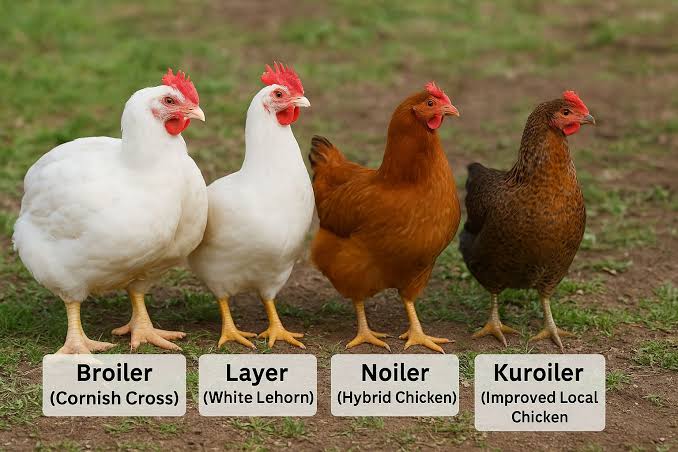
2. Broiler Chicken
Broilers are chickens specifically bred for rapid meat production. They are among the most common commercial chickens raised in Nigeria.
Growth rate
Broilers have very fast growth. With good genetics, nutrition and management, many commercial broilers reach market weight at around 5–8 weeks, depending on the target market and breed.
Feed consumption
Broilers consume relatively large quantities of feed because rapid growth requires substantial nutrients. They are normally given:
- Starter feed
- Grower/finisher feed
Feed efficiency is extremely important because feed is usually one of the largest costs in broiler farming.
Egg production
Broilers are not kept primarily for egg production. They are unsuitable when the main objective is commercial table-egg production.
Maturity age
Broilers reach slaughter/market maturity much earlier than layers, generally within several weeks rather than several months.
Advantages
- Very rapid growth
- Short production cycle
- High demand for chicken meat
- Can generate several production cycles per year
- Efficient meat production when properly managed
Disadvantages
- High feed requirements
- Sensitive to poor management
- Heat stress can reduce performance
- Poor ventilation can cause serious problems
- Fast growth can increase leg and metabolic problems
Suitability for Nigerian farmers
Excellent for meat production, provided the farmer can control feed costs, heat, ventilation, disease and marketing.
⸻
3. Layer Chicken
Layers are chickens genetically selected primarily for high egg production.
Popular commercial layer strains include Isa Brown, Lohmann Brown, Hy-Line and other commercial hybrids.
Growth rate
Layers grow more slowly than broilers because their bodies are developed primarily for efficient egg production rather than rapid meat gain.
Feed consumption
A mature commercial layer commonly consumes around 100–120 g of feed per day, although actual intake changes with breed, body weight, temperature, feed quality and production level.
Egg production
Good commercial layers can produce approximately 280–330 eggs per year under suitable commercial conditions, although actual production varies considerably.
Maturity age
Many commercial layers begin laying at approximately 18–22 weeks.
Advantages
- High egg production
- Regular cash flow from egg sales
- Long productive period
- Strong commercial demand for eggs
- Good feed-to-egg efficiency when properly managed
Disadvantages
- Requires consistent feed supply
- Poor nutrition quickly affects egg production
- Heat stress can reduce laying
- Requires good lighting and management
- Commercial layers are less suitable for meat production
Suitability for Nigerian farmers
Excellent for commercial egg production, particularly where there is a reliable market for eggs.
⸻
4. Kuroiler Chicken
Kuroiler is a dual-purpose chicken developed for production under relatively low-input conditions. It has become attractive to farmers looking for a bird that can provide both meat and eggs.
Growth rate
Kuroilers grow faster than most indigenous chickens but generally slower than commercial broilers.
Feed consumption
They can utilize a combination of formulated feed and some supplementary feed resources, but good-quality commercial feed is still important for achieving better growth and egg production.
Egg production
Kuroiler hens can produce considerably more eggs than traditional village chickens, although they do not normally match specialized commercial layers.
Maturity age
They generally reach sexual maturity earlier than traditional local chickens, with laying often beginning around 5–6 months, depending on management and strain.
Advantages
- Dual-purpose bird
- Relatively adaptable
- Suitable for smallholder farmers
- Produces both meat and eggs
- Can perform under semi-intensive systems
Disadvantages
- Lower egg production than specialized layers
- Slower meat growth than commercial broilers
- Performance depends heavily on nutrition and genetics
Suitability for Nigerian farmers
Good choice for small and medium-scale farmers who want both meat and eggs.
⸻
5. Sasso Chicken
Sasso chickens are colored or dual-purpose birds used in many developing poultry systems. They are valued for combining reasonable growth with egg production.
Growth rate
Sasso birds generally grow faster than indigenous chickens but slower than intensive commercial broilers.
Feed consumption
They require adequate protein, energy, minerals and vitamins during growth. Feed requirements increase as the bird becomes larger.
Egg production
Sasso hens can produce substantially more eggs than traditional chickens, although production depends on the particular Sasso strain.
Maturity age
Under good management, hens may begin laying at approximately 5–6 months.
Advantages
- Dual-purpose characteristics
- Good meat quality
- Can perform under different management systems
- More productive than many local chickens
- Suitable for farmers targeting both eggs and meat
Disadvantages
- Requires good nutrition for maximum performance
- Not as fast-growing as specialized broilers
- Not as productive in eggs as specialized layers
Suitability for Nigerian farmers
Suitable, especially for farmers interested in hardy dual-purpose birds rather than highly specialized commercial production.
⸻
6. Cobb Chicken
Cobb is a major commercial broiler genetic line used for meat production.
Growth rate
Cobb broilers are selected for rapid growth and good feed conversion. Under proper commercial management, they can reach market weight in approximately 5–8 weeks, depending on the target weight.
Feed consumption
They require nutritionally balanced broiler feed. Because they grow rapidly, poor-quality feed can quickly reduce performance.
Egg production
Cobb broilers are not intended for commercial egg production.
Maturity age
Commercial market maturity is generally reached within several weeks.
Advantages
- Fast growth
- Good feed conversion
- High meat yield
- Suitable for intensive production
- Strong commercial performance
Disadvantages
- Sensitive to poor management
- Heat stress can significantly affect performance
- Requires quality feed
- Can develop leg and metabolic problems if growth and management are poorly controlled
Suitability for Nigerian farmers
Excellent for commercial broiler production, particularly where good housing, ventilation, feed and veterinary support are available.
⸻
7. Ross Chicken
Ross is another major commercial broiler genetic line. Ross broilers are widely used for efficient meat production.
Growth rate
Ross broilers are selected for rapid growth and efficient conversion of feed into body weight.
Feed consumption
They require properly formulated starter and finisher diets. Feed intake increases considerably as the birds age.
Egg production
Ross broilers are not normally raised as commercial egg layers.
Maturity age
They can reach commercial slaughter weights within approximately 5–8 weeks, depending on the production system and desired market weight.
Advantages
- Rapid growth
- Good feed efficiency
- High meat yield
- Suitable for intensive poultry production
- Well-established commercial genetics
Disadvantages
- Requires careful management
- Heat stress can reduce feed intake and growth
- Poor ventilation can increase health problems
- Feed costs can be high
Suitability for Nigerian farmers
Very suitable for commercial meat production, especially for farmers with good management systems.
⸻
8. Cornish Cross
Cornish Cross refers to a commercial meat-type chicken commonly associated with rapid growth and high breast-meat yield.
Growth rate
It is an extremely fast-growing meat bird and can reach market weight in approximately 6–8 weeks, depending on the production target.
Feed consumption
Because of its rapid growth, it consumes substantial amounts of feed. Feed efficiency is important for profitability.
Egg production
It is not suitable for commercial egg production.
Maturity age
Market maturity is normally reached within several weeks.
Advantages
- Very fast growth
- Excellent meat yield
- Large breast meat
- Short production cycle
Disadvantages
- Requires careful feeding
- More vulnerable to management-related leg and metabolic problems
- Heat stress can be serious
- Not suitable for egg production
Suitability for Nigerian farmers
Suitable for intensive meat production, but farmers must pay particular attention to heat management, ventilation, stocking density and nutrition.
⸻
9. Black Australorp
Black Australorp is an established dual-purpose breed known particularly for egg production and good body size.
Growth rate
It grows at a moderate rate and is slower than modern commercial broilers.
Feed consumption
Feed consumption is moderate compared with large commercial broilers, but birds still require balanced nutrition for good growth and laying.
Egg production
Well-managed Australorp hens can produce around 200–300 eggs per year, depending on strain and management.
Maturity age
Pullets may begin laying around 5–6 months, although individual birds vary.
Advantages
- Good egg production
- Reasonable meat production
- Attractive black plumage
- Suitable for dual-purpose farming
- Can adapt to different management systems
Disadvantages
- Slower growth than broilers
- Lower egg output than specialized commercial layers
- May not be as profitable as hybrids in highly intensive commercial systems
Suitability for Nigerian farmers
Suitable for small and medium-scale farmers, especially those interested in a traditional dual-purpose breed.
⸻
10. Rhode Island Red
Rhode Island Red is a popular dual-purpose breed and is especially known for brown eggs.
Growth rate
It has moderate growth and does not grow as quickly as commercial broilers.
Feed consumption
Feed requirements are moderate but increase as birds mature and begin laying.
Egg production
Good Rhode Island Red hens can produce approximately 200–300 eggs per year, depending on genetics and management.
Maturity age
Pullets commonly begin laying at around 5–6 months.
Advantages
- Good egg production
- Dual-purpose characteristics
- Strong body size
- Brown eggs
- Useful for breeding and smallholder production
Disadvantages
- Slower growth than broilers
- Lower egg production than specialized commercial hybrids
- Purebred birds may be less efficient commercially than modern hybrids
Suitability for Nigerian farmers
Good for smallholder and semi-intensive farmers who want both eggs and meat.
⸻
11. Isa Brown
ISA Brown is a commercial layer hybrid specifically selected for efficient egg production.
Growth rate
It has moderate growth during the pullet stage because the objective is to develop a healthy laying bird rather than a heavy meat bird.
Feed consumption
Adult hens commonly consume approximately 105–120 g of feed per day, depending on environmental conditions, body weight and production.
Egg production
Under good commercial management, ISA Brown hens can produce well over 300 eggs during a production cycle, although results vary with management and flock quality.
Maturity age
Many ISA Brown pullets begin laying around 18–20 weeks.
Advantages
- Excellent egg production
- Good feed efficiency
- Brown eggs
- Early onset of laying
- Strong commercial value
Disadvantages
- Requires good nutrition
- Heat stress can reduce production
- Poor management can cause egg-size and shell-quality problems
- Not designed for efficient meat production
Suitability for Nigerian farmers
Excellent for commercial egg farmers who can provide good feed, lighting, ventilation, vaccination and flock management.
⸻
12. Lohmann Brown
Lohmann Brown is another highly productive commercial brown-egg layer.
Growth rate
It develops moderately during the pullet period and is selected for efficient egg production rather than rapid meat growth.
Feed consumption
Adult feed intake is commonly around 105–120 g per day, but actual consumption depends on temperature, body size, feed quality and production level.
Egg production
Well-managed Lohmann Brown hens can produce more than 300 eggs over a commercial laying cycle, depending on management and genetic potential.
Maturity age
Pullets commonly start laying around 18–21 weeks.
Advantages
- High egg production
- Efficient feed utilization
- Good brown egg production
- Early maturity
- Suitable for commercial layer farms
Disadvantages
- Requires consistent management
- Poor nutrition reduces production
- Heat stress can affect laying performance
- Not an ideal meat bird
Suitability for Nigerian farmers
Excellent for commercial egg production where farmers can maintain good environmental and nutritional management.
⸻
13. Local Nigerian Chicken Breeds
Nigeria has many indigenous chicken types adapted to local environments. These birds are often called local chickens, native chickens or village chickens.
They differ considerably in body size, color, growth and productivity.
Growth rate
Local chickens generally grow more slowly than commercial broilers and improved dual-purpose breeds.
Feed consumption
They usually have lower total feed requirements because they are smaller birds, but farmers should not confuse low feed intake with high productivity. Proper supplementation improves growth and reproduction.
Egg production
Traditional local hens usually produce far fewer eggs than commercial layers. Depending on the bird and management system, annual production may be roughly 50–150 eggs, although improved management and genetics can increase output.
Maturity age
Local chickens often mature later than commercial layers, with sexual maturity commonly occurring around 5–7 months or later.
Advantages
- Adapted to local environmental conditions
- Generally hardy
- Useful for free-range and semi-intensive systems
- Good consumer acceptance
- Lower initial production requirements
- Can survive under relatively low-input conditions
Disadvantages
- Slow growth
- Low egg production compared with commercial layers
- Small body size
- Variable performance
- Poorer feed efficiency for intensive meat production
Suitability for Nigerian farmers
Very suitable for smallholder farmers, particularly where farmers have limited capital or prefer free-range and semi-intensive systems.
⸻
How Nigerian Farmers Should Choose a Chicken Breed
There is no single “best chicken breed” for every farmer.
Your best choice depends on what you want to produce.
| Farming goal | Suitable choices |
| Fast meat production | Broiler, Cobb, Ross, Cornish Cross |
| Commercial egg production | ISA Brown, Lohmann Brown and other commercial layers |
| Meat + eggs | Noiler, Kuroiler, Sasso |
| Smallholder farming | Noiler, Kuroiler, local chickens |
| Free-range/semi-intensive | Local chickens, Noiler, Kuroiler, Sasso |
| Dual-purpose breeding | Black Australorp, Rhode Island Red |
| Intensive commercial farming | Cobb, Ross, commercial layer strains |
Important Advice for Young Chicken Farmers
Do not choose a breed based only on growth rate. A fast-growing chicken can still produce poor profit if feed costs, mortality, heat stress or market prices are unfavorable.
Before buying chicks, ask the hatchery about:
- The exact breed or strain.
- Vaccination status.
- Parent-stock quality.
- Expected growth or laying performance.
- Feed requirements.
- Mortality history.
- Recommended management system.
- Whether the chicks are suitable for your production objective.
Breed is only one part of poultry success
Even the best genetics cannot compensate for poor management. Farmers should pay close attention to:
- Quality feed
- Clean drinking water
- Proper brooding temperature
- Adequate ventilation
- Correct stocking density
- Vaccination
- Biosecurity
- Lighting for layers
- Litter management
- Heat-stress prevention
- Regular weight monitoring
- Proper record keeping
- Good marketing
Final takeaway
For a Nigerian farmer focused on fast meat production, commercial broilers such as Cobb and Ross are strong options. For commercial egg production, specialized layers such as ISA Brown and Lohmann Brown are more appropriate. Farmers wanting both meat and eggs can consider Noiler, Kuroiler or Sasso, while local Nigerian chickens remain valuable for low-input and smallholder systems.
The most profitable breed is ultimately not simply the one that grows fastest or lays the most eggs—it is the breed that matches your farm’s management ability, available feed, climate, capital and local market.
Leave a Reply